
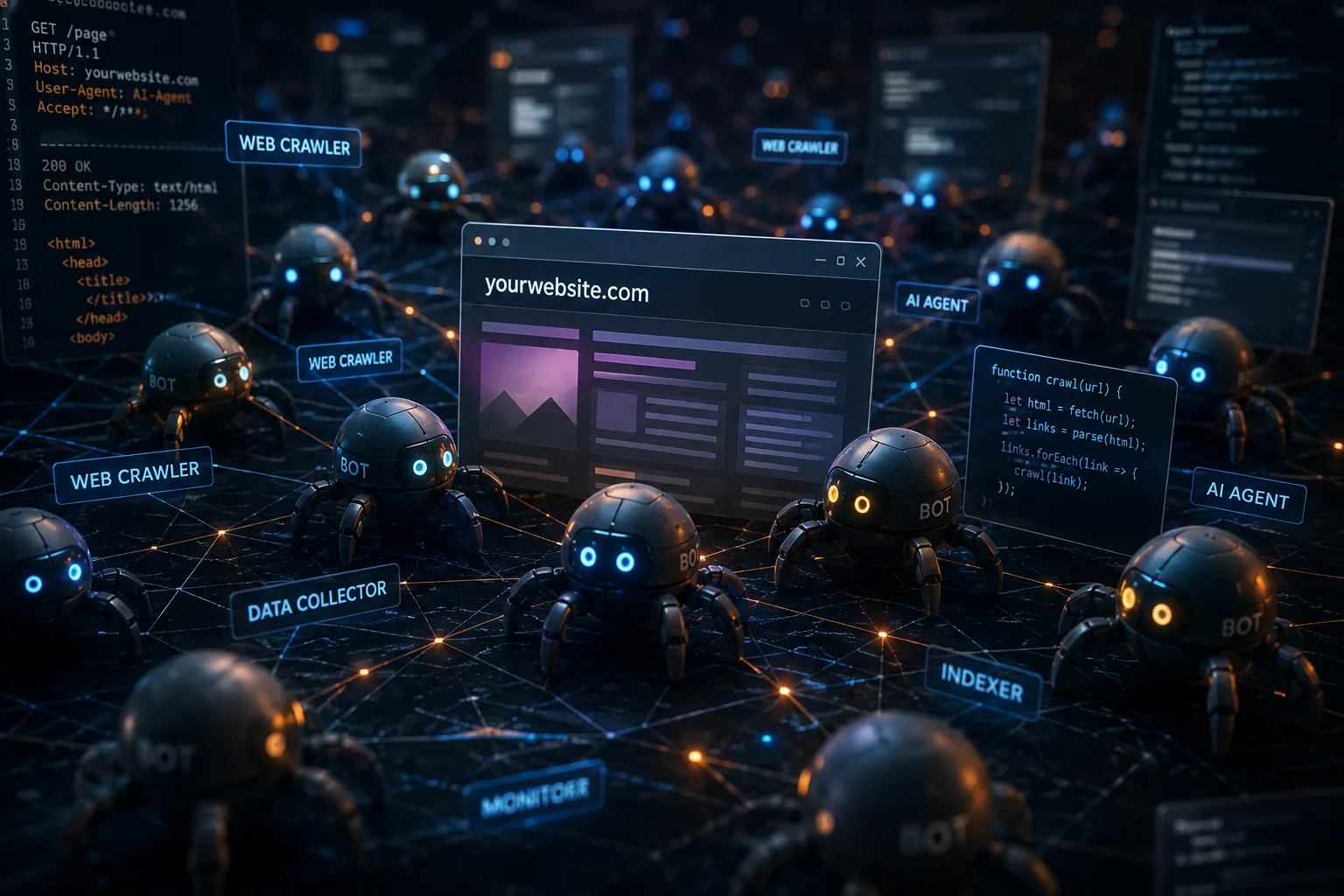
Cloudflare data shows automated traffic now exceeds human traffic online, marking a historic shift in how the web operates.
The internet has officially crossed a threshold that many industry leaders expected years from now.
On June 3, Cloudflare CEO Matthew Prince posted on X that, for the first time in internet history, automated traffic had surpassed human traffic online.
"Welp, that happened faster than I predicted. Thought it would be end of 2027, then early 2027, but agentic traffic growing so fast that bots have now passed human traffic online for the first time in the Internet's history."
The statement was accompanied by new data from Cloudflare Radar showing that bots now account for approximately 57.5% of HTTP requests to HTML content, while humans account for just 42.5%.
The milestone arrived much sooner than expected. Prince had previously estimated the crossover point would occur sometime in 2027. Instead, it happened roughly eighteen months earlier.
For most internet users, the announcement may seem like an interesting statistic.
For builders, publishers, marketers, SaaS founders, investors, and anyone operating an online business, it could signal one of the most important structural shifts the web has experienced since the rise of mobile devices.
The Internet Was Built Around Humans
For nearly three decades, the internet has operated on a fairly simple assumption: a person visits a website.
That assumption is deeply embedded into almost everything online. Advertising platforms measure impressions and clicks. Publishers optimize content for readers. SaaS companies build onboarding experiences designed to move users toward activation, while ecommerce businesses spend millions refining product pages and checkout flows to maximize conversions.
Entire industries have been built around understanding human behavior.
The web itself evolved around those behaviors. Search engines helped people find information, websites competed for attention, and businesses fought for visibility. Success was measured by attracting more visitors, generating more engagement, and ultimately converting more humans into customers.
Cloudflare's data does not suggest humans are disappearing from the internet. People are still making purchases, creating companies, subscribing to software, and driving demand across the digital economy. What's changing is the layer between users and websites.
Increasingly, software is becoming the first visitor.
Not The Bots You're Thinking Of
When people hear the word "bot," they often think of spam accounts, malicious traffic, or automated scrapers collecting data across the web.
Those forms of automation certainly still exist, but they are no longer the most interesting part of the story. The growth pushing automated traffic beyond human traffic is increasingly being driven by a new category of software: agentic AI.
Unlike traditional bots that simply index pages or scrape content, AI agents are designed to perform tasks on behalf of users. They can research products, compare pricing, summarize information, evaluate competitors, search for answers, and gather data from thousands of websites in seconds. To the user, the experience feels simple. They ask a question and receive an answer.
Behind the scenes, however, that answer may require thousands of automated requests across the internet.
Matthew Prince highlighted this growing asymmetry earlier this year during SXSW. A person shopping for a camera might manually visit five websites before making a decision, while an AI agent performing the same task could visit thousands. The user sees one answer. The internet sees thousands of requests.
That difference helps explain why automated traffic is growing so rapidly.
Why This Matters For Builders
For founders, marketers, publishers, and software companies, this is far more than an interesting statistic.
For years, businesses have relied on traffic as one of the most important indicators of growth. More visitors generally meant more awareness, more opportunities for conversion, and more potential customers. But as AI agents become a larger percentage of web traffic, that assumption becomes more complicated.
Imagine you're a startup founder reviewing analytics for your product. Traffic is increasing. Historically, that would have been viewed as a positive signal.
Today, one of the first questions may become: who is actually visiting?
A growing share of traffic could represent AI systems researching products on behalf of users. Those visits may still be valuable, but they behave differently than traditional visitors. They do not browse websites the same way people do, they do not click through pages in predictable patterns, and they may never even view a landing page the way a human would.
As a result, businesses may need to rethink how they interpret engagement, acquisition, and discovery. Traffic alone may no longer tell the full story.
The Future Of Search And Discovery
One of the biggest long-term implications of this shift involves how products are discovered online.
For decades, discovery followed a familiar process. A person searched Google, opened several tabs, compared products, read reviews, and eventually made a decision. Companies competed for those clicks, and entire industries emerged around improving search rankings and increasing visibility.
AI assistants are beginning to change that process.
Instead of manually researching ten products, a user can ask an AI assistant for recommendations. The assistant gathers information, evaluates options, compares features, and presents a summary. The user still makes the final decision, but much of the research is now handled by software.
That changes the nature of competition online. Rather than competing solely for human attention, businesses may increasingly find themselves competing for inclusion within AI-generated recommendations.
The companies that adapt quickly to this new reality could gain a significant advantage in the years ahead.
A Potential Repricing Of The Web
The implications may extend well beyond search and product discovery.
Much of the modern internet economy is built around human attention. Advertising networks, affiliate businesses, subscription products, publishers, ecommerce brands, and countless startups all rely on attracting and measuring that attention.
If software increasingly becomes the primary visitor, many traditional measurements become less meaningful.
Page views. Sessions. Clicks. Impressions.
These metrics were developed during an era when the overwhelming majority of internet activity came from people. Today, that reality is changing.
The challenge is not simply that bots exist. The challenge is that many of these bots now represent real users operating through AI systems. That distinction matters.
A website may receive a visit from an AI agent researching a purchase on behalf of a human customer. The request is automated, but the underlying intent is very real. Businesses that continue treating all traffic as either entirely human or entirely bot-driven may find themselves misunderstanding what is actually happening inside their own systems.
What Happens Next?
The internet has gone through several defining transitions over the past three decades.
The rise of search engines changed how information was discovered. Social media changed how information spread. Mobile devices changed how people interacted with the web.
Artificial intelligence may be driving the next major shift.
Humans remain at the center of the internet economy. They still create businesses, buy products, subscribe to software, and make decisions. But increasingly, software is becoming the intermediary between people and the web itself.
That raises important questions for founders, marketers, publishers, and investors. How should products be designed when software is often the first visitor? How should companies measure engagement when AI systems increasingly participate in the discovery process? And how should businesses compete in a world where recommendations may be generated by machines rather than chosen directly by people?
There are still more questions than answers.
What is clear, however, is that a historic milestone has been reached. For the first time in the history of the internet, machines generate more web traffic than humans.
And the web was never originally designed for that reality.