

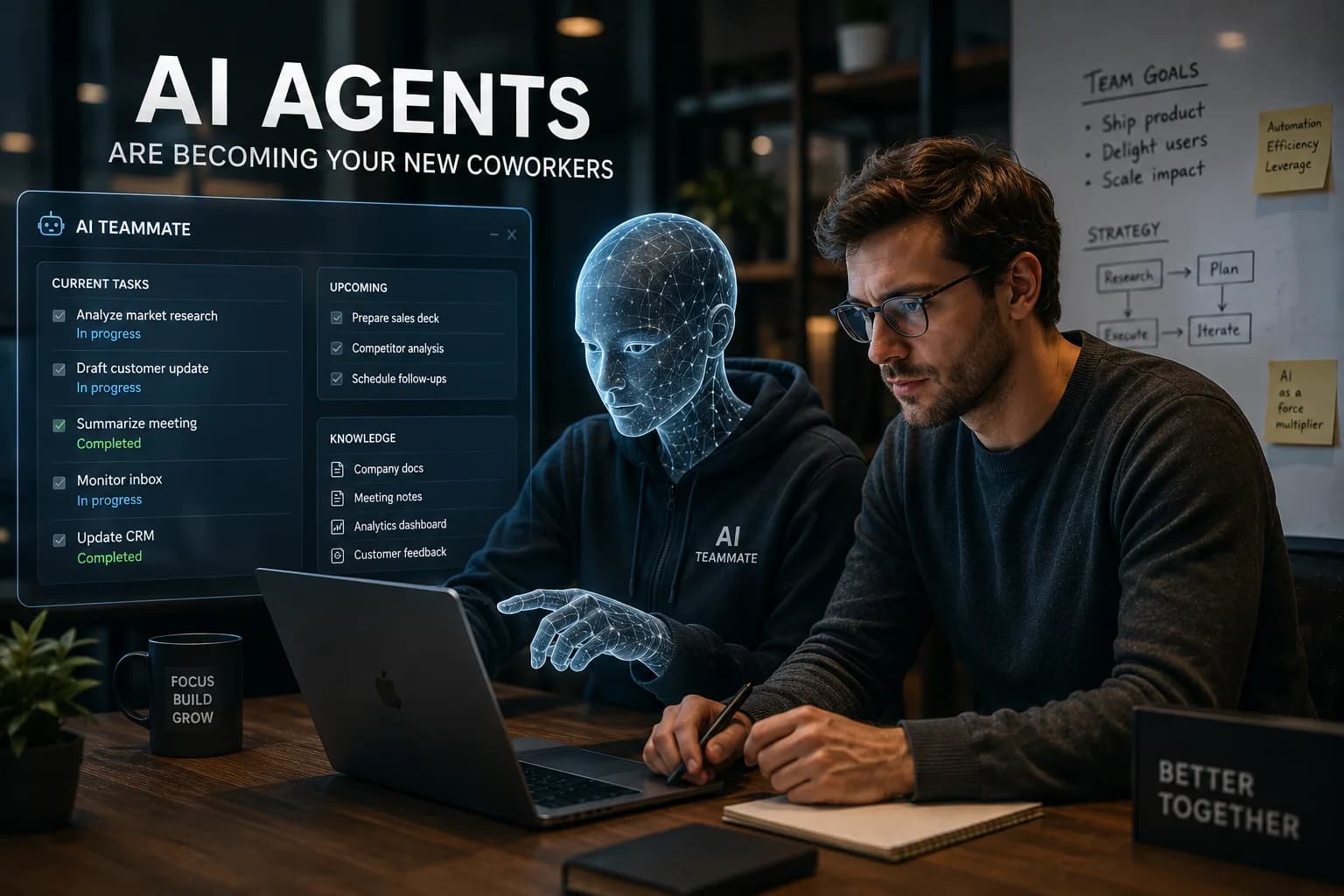
AI Agents Are Becoming Your New Coworkers 🤖
Startups are no longer just selling AI tools. Increasingly, they're building AI teammates.
When most people think about artificial intelligence in the workplace, they picture a tool sitting alongside an employee. It might help write emails, generate code, summarize meetings, or answer questions faster than traditional software. The human remains at the center of the workflow, while the AI acts as an assistant.
That framing may already be starting to change.
This week, startup Convey announced a $38 million funding round led by Andreessen Horowitz. While the funding itself is notable, what stands out is how the company describes its product. Convey is not positioning itself as another AI productivity tool. Instead, it describes its technology as a digital teammate capable of handling work that would traditionally require a person.
The distinction may sound subtle, but it reflects a broader shift happening across the technology industry. For years, software companies focused on helping employees work more efficiently. Increasingly, startups are asking a different question: what if software could perform meaningful portions of the work itself?
From Software To Teammates
Traditional software has always required a human in the loop. Project management platforms organize work, customer support tools streamline communication, and analytics dashboards help teams make decisions. Even the most powerful applications ultimately depended on someone logging in, interpreting information, and taking action.
The latest generation of AI products is moving beyond that model. Rather than simply providing information, many AI systems are being designed to execute workflows on their own. They can monitor inboxes, draft responses, gather information, update records, summarize meetings, and coordinate actions across multiple systems with limited human involvement.
That shift helps explain why the language surrounding AI products has changed so dramatically over the last year. Companies increasingly talk about agents, teammates, digital workers, and AI employees rather than assistants. The technology may not always be fully autonomous yet, but the ambition is clearly moving beyond productivity software and toward systems that can actively contribute to getting work done.
Why Investors Are Paying Attention
The excitement around AI agents is not just about technology. It is about economics.
For decades, businesses adopted software because it made employees more productive. A better CRM helped sales teams close more deals. Better communication tools helped organizations move faster. Better analytics helped leaders make better decisions. The employee remained the center of the process, while software acted as a force multiplier.
AI agents introduce a different possibility. Instead of asking how software can help a worker complete a task, companies are increasingly exploring whether software can perform parts of that task itself.
That potential is one reason venture capital continues pouring into the category. Investors are not simply betting that AI will improve existing workflows. Many are betting that AI agents could eventually handle significant portions of operational, administrative, research, and knowledge work that currently requires dedicated employees.
Whether those expectations prove realistic remains an open question. What is clear is that investors increasingly view AI agents as a much larger opportunity than traditional productivity software.
The New Hiring Question
Historically, growth inside a startup often meant expanding the team. More customers created more support tickets. More revenue created more operational complexity. More projects required more specialists.
AI agents are beginning to introduce a new variable into that equation.
Instead of immediately hiring for every new responsibility, some founders are experimenting with AI systems that can absorb portions of the workload. A founder may use AI to draft customer communications, conduct research, summarize meetings, generate content, analyze feedback, or automate repetitive administrative tasks that previously required additional headcount.
That does not mean companies are replacing employees overnight. Most AI systems still require oversight, review, and human judgment. They make mistakes, struggle with ambiguity, and often lack important business context.
However, the conversation itself is changing. For a growing number of startups, the first question is no longer simply, "Who should we hire?" Increasingly, it may be, "Can software handle this first?"
Builders Are Becoming Managers Earlier
One of the more interesting effects of this shift is how it changes the role of founders themselves.
Historically, solo founders and small teams were constrained by the number of hours they could personally invest in marketing, development, research, support, and operations. Building a company often meant wearing multiple hats simultaneously until growth justified additional hires.
Today's founders have access to AI systems that can contribute across many of those functions. They can generate marketing copy, analyze customer feedback, summarize documents, assist with development, and automate repetitive workflows. None of these systems are perfect, but together they can dramatically expand what a small team is capable of accomplishing.
As a result, some founders are spending less time performing every individual task themselves and more time coordinating systems, reviewing outputs, and directing workflows. In many ways, they are becoming managers much earlier than previous generations of entrepreneurs, except that some of the contributors they manage happen to be software.
The Limits Of The Hype
Of course, there is still a significant gap between an impressive demonstration and a reliable employee.
Many AI companies are currently selling a vision of autonomous work that remains difficult to achieve consistently in practice. Reliability, security, accountability, context retention, and decision-making remain significant challenges. Most organizations still require humans to supervise outputs, approve actions, and step in when systems fail.
History also suggests that technological shifts are rarely as simple as replacing one thing with another. New technologies often eliminate certain tasks while creating entirely new categories of work. The arrival of spreadsheets did not eliminate accountants. The rise of cloud software did not eliminate IT departments.
AI agents may follow a similar path. Rather than replacing workers outright, they may change the nature of the work being performed and increase expectations around productivity.
The Workplace Is Already Changing
Whether companies call them agents, coworkers, teammates, or digital employees, AI systems are becoming increasingly embedded in how work gets done.
The significance of Convey's funding round is not simply that another AI startup raised money. It reflects where many founders, investors, and operators believe the market is heading. The conversation is gradually moving away from how AI can help employees work faster and toward how much work software can perform on its own.
That does not mean the future workplace will be fully automated. It does suggest, however, that the relationship between workers and software is evolving. For decades, software existed primarily as a tool used by employees.
Increasingly, startups are building software designed to act more like a teammate.
And that distinction may define the next chapter of the software industry.